

The Key to Life
The Mental Science of Success – Online Edition
The River of Fortune
Over the years, some of those we interacted with recognized in us the success they wanted for themselves. They wanted to be more and do more but didn’t know how. They would ask us, “How do you do it?”
Then over lunches, emails and phone calls we would talk about their infinite possibility, mental hang-ups and limiting beliefs and when they caught the vision, they would soon find themselves taking the actions and making the alterations that changed their lives.
But it seemed that some of those we talked with could never really make the change no matter how hard they tried. It was as if they were fighting an uphill battle that they just couldn’t win.
We watched them hitting mental blocks that were clearly imagined. They were making mountains out of molehills. Things that we would just blow through as if they didn’t exist would stop them dead in their tracks.
We would even provide solutions to them and tell them how to get past their blocks. They could see what we were saying and even felt like it was a good idea. But, the vision would fade and soon enough they would be struggling again with something just as simple to overcome.
We recognized my previous self in them. It was like looking at my own past. At some point, we looked back on my life and asked myself, “What was the Big Difference?” Before the change I had all the invalid excuses they were giving me and more. And at the time, my excuses seemed just as real to me as their excuses were to them.
We know that immediately following my experience, I didn’t have any additional skills, contacts or opportunities than I had prior to the experience. Nothing in my outer world had changed at all. The only change that took place happened inside of me. In my mind. And even then, I experienced the change and although I could see my limitless potential I didn’t consciously know how to achieve it. I didn’t know the answers to all the questions. I didn’t consciously know how to be successful. But I I could see what prevented it. I somehow knew what did and what did not move me forward. In addition, I was compelled forward. I thrived on it. It was exactly opposite of what I had done in the past. And as I moved forward, success just seemed to magically flow to me without effort. I saw opportunities and recognized them as if I was drawn to them and they to me.
Before the change, it was as if I was standing in a river and my goals were upstream from me. It was as if no matter how hard I tried the current was always stronger than I was and even though I would make a little progress toward my goals, eventually I would be swept back downstream to where I started. Before the change, the thought of getting a new job was draining and depressing. When I tried to force myself to succeed regardless of my excuses, I mentally shut down. There was no creativity, no insight and no motivation.
Now, after the change, it was as if I was still standing in the river, but the current had changed so that my goals were now downstream and I felt like I was trying not to go toward them too fast and be thrown into situations I felt unequipped to manage. Over time I learned to just go with the flow and that new situations posed no real threat. In fact, now I thrive on new experiences and enjoy them and the lessons I learn from them.
Now the thought of getting a higher paying job was invigorating and energizing. I felt empowered and enthusiastic! For me, it was a night and day difference. Through a miracle, the river of fortune had actually changed direction and begun flowing toward success!
We wondered whether or not someone could be where I was, a failure, and then immediately change course and become a success like I had, without having had a powerful spiritual experience like I did. The answer came when we finally understood what had happened to me and realized what we had been fighting against…
The Iceberg
Before we can understand the force that holds us back or pushes us forward, we have to understand a few key things…
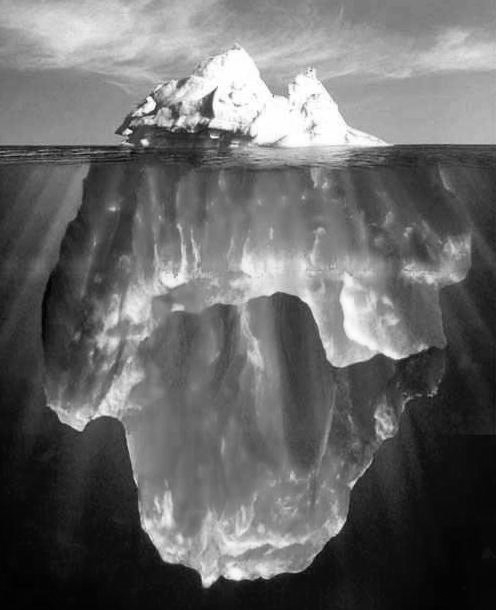
An iceberg floats in the ocean with about 13% of the mass above water and 87% below the water. From above the water, we see only “the tip of the iceberg”.
Our conscious mind is like the tip of the iceberg that we see and are aware of. This is the part of our mind that controls ALL of our voluntary actions. Voluntary actions are things that we choose and focus on, for example we might choose to wiggle our fingers, get dressed, or to learn a new skill.
Our subconscious mind on the other hand represents the majority of the iceberg which is hidden under the water. This is the part of our mind that we are not consciously aware of and which controls ALL of our involuntary actions. Involuntary actions include bodily functions like the rhythm and intensity of our heart beat, what hormones are released into our bloodstream which creates the emotional response we experience as we react to external stimulus. It governs everything in our lives that we are not consciously in control of or that we do without thinking about it.
Your subconscious mind is far more powerful than your conscious mind. To put it into perspective, Dr. Joe Dispenza, (who was featured on the popular documentary “What the Bleep Do We Know”), wrote, “Our human brain processes 400 billion bits of information every second; however, we are only aware of about 2000 of those billions of bits of data. We therefore are not aware of all of that information because we literally are not attending to those stimuli.” (Dispenza, 2001)
The 2000 bits of information that we are aware of, which our brain processes each second, happens in the conscious mind. The majority of the remaining 3,999,998,000 bits of information our brain processes every second is done by the subconscious mind. It is that powerful! It sees everything and presents only the relevant information to the conscious mind. Relevant information is determined by what the conscious mind is presently focused on. Everything else is withheld and handled by the subconscious mind using predefined programs.
“The unconscious mind holds all awareness that is not presently in the conscious mind. All memories, feelings and thoughts that are out of conscious awareness are by definition ‘unconscious.’ It is also called the subconscious and is known as the dreaming mind or deep mind.
Knowledgeable and powerful in a different way than the conscious mind, the unconscious mind handles the responsibility of keeping the body running well. It has memory of every event we’ve ever experienced; it is the source and storehouse of our emotions; and it is often considered our connection with Spirit and with each other.
No model of how the mind works disputes the tremendous power which is in constant action below the tip of the iceberg. The conscious mind is constantly supported by unconscious resources. Just think of all the things you know how to do without conscious awareness. If you drive, you use over 30 specific skills… without being aware of them. These are skills, not facts; they are processes, requiring intelligence, decision-making and training.
Besides these learned resources which operate below the surface of consciousness there are important natural resources. For instance, the unconscious mind regulates all the systems of the body and keeps them in harmony with each other. It controls heart rate, blood pressure, digestion, the endocrine system and the nervous system, just to name a few of its natural, automatic duties.” – Process Coaching Center, https://processcoaching.com/unconscious.html
If you make a conscious decision to do something, then you are using your conscious mind. Everything that you do without focused and conscious attention is handled by your subconscious mind. Because you are only able to focus on a very small amount of your life experience at any given time, the vast majority of your life experience is handled by these preprogrammed scripts run in the subconscious.
Let’s take a more detailed look at two real and common examples of how the conscious and subconscious minds work together in our daily lives…
The Iceberg in Action
Signing Your Name
Let’s use an example to illustrate how the subconscious mind impacts everything we do:
When you decide to write your signature on a piece of paper, you have made a conscious decision. This is an example of what you might do with your conscious mind. But consider how your subconscious mind influences your signature and how it takes over the fulfilment of your conscious decision…
A good signature analyst can look at your signature and determine your self-esteem, your approach to life, whether you are outgoing or shy, confident or insecure, if you are guarded and defensive or open and trusting and a myriad of other things. (For more information, research “Signature Analysis”)
Although you consciously decided to write your signature, (the 4%), your subconscious mind effortlessly impacts and creates every letter and detail of your signature, (the 96%). Your subconscious mind calculated how to fit your signature in the space provided, how tall to write each letter, what type of slant to give it and a myriad of other features and unique traits. All this was done instantly and without effort. So much so, that if you consciously wanted to change your signature, it would require a great deal of focus, effort and practice.
You didn’t consciously choose to write that information into your signature! It was all put in there subconsciously without you even knowing about it.
In this same way, everything you consciously choose to do is fulfilled by your subconscious mind. If you decide to drive to work, your subconscious mind takes over so much so that you may be listening to the radio, talking on the phone or even eating a meal. Your subconscious mind is running scripts and programs that were created when you learned to drive. These scripts include instructions regarding how close to get to curbs, when to slow down to stop, how to react to various signs and signals and even how to adjust to other drivers. Anything you are not consciously focused on is performed by the subconscious mind.
Non-Verbal Communication
Just like our signatures give off a tremendous wealth of information about who we are, so too do we constantly give off subtle non-verbal, subconscious insights about who we are, what we feel and think and even our intentions. These insights are clear, profound and accurate.
We give others the context by which they should measure everything we communicate the moment they see us walk in the door.
An unconfident person will naturally walk in a room and subconsciously tell everyone that they are not confident in themselves. They enter a room slowly, with a generally solemn disposition, their head down, their feet dragging, with low energy and giving off a thousand subtle messages telling everyone what they think of themselves.
Everyone in the room will immediately recognize the subconscious communication of their self-image and react accordingly. Everyone in the room will instinctively know that the person with the low self-confidence should be questioned and second guessed before believing or accepting anything they say. And why shouldn’t they be questioned?! If a person doubts themselves, and they know themselves better than anyone else, shouldn’t others take their cues from them and doubt them also?
So without realizing it, the person is creating a world that doubts them and questions them. This in turn reinforces and solidifies the person’s self-image as unconfident and we have come full circle.
On the other hand, if a person confidently and quickly entered a room with a determined stride, in high spirits, well dressed, head high and ready to take charge, we would all immediately give them our full attention and listen to every word they had to as if it were critical. They haven’t even said anything and we have placed them in a context solely based on what they present to us. Again, it all comes from the way that this person presents themselves. And that comes naturally from the way they view themselves.
You Are the Expert on YOU
Now, if you learn nothing else from this chapter, learn this!!! Everyone naturally assumes that YOU are the expert on YOU. Who would know YOU better than YOU? So, whatever you tell them about yourself MUST be true! If you tell people that you don’t have confidence in yourself, then they will assume that they shouldn’t have confidence in you either. So, your subconscious communication that tells others how you see yourself is essential to understand on your path to success. When you see yourself as a failure, you subconsciously communicate that to others in a thousand different ways. And because they believe what you tell them about you, they treat you like a failure.
If you give off the signs and signals that tell others you are friendly, successful, intelligent, upbeat, wealthy, trustworthy and reliable then they believe it… You’re the expert on YOU!
I have a friend who tries to give the appearance that he is confident. Stands straight, looks people in the eye and does everything he thinks he is supposed to do to portray confidence. He even tells others exaggerated stories about how he did something or other and talks himself up in an attempt to convince others and perhaps himself that he is capable and confident. The problem is that 93% of our communication is nonverbal. How we dress, our posture, handshake and eye contact only addresses a minute fraction of these nonverbal communications. The rest is expressed in our voice inflections, energy levels, gestures, eye movements, “microexpressions” and a myriad of other ways which cannot be faked. Nearly everyone he tries to convince feels his lack of confidence. And the harder he tries, the more they can feel it.
If you nonverbally tell others that you are lazy, selfish, poor, mean, critical, insecure and uncertain, then they will believe that too.
All this communication happens quietly behind the scenes usually without either person consciously knowing about it. The only thing that generally occurs to the conscious mind is an illogical “feeling” or unfounded “intuition” about the other person.
One of the many ways our subconscious mind communicates is called, “microexpressions”. Here are some points that HowStuffWorks.com makes regarding microexpressions;
“Microexpressions can be as brief as about 1/25 of a second [source: Ekman]. They occur so fast that they’re often not perceived by the conscious mind of either the expresser or the person observing the expression. As few as 10 percent of people are even aware of seeing microexpressions when tested [source: Zetter].
Microexpressions can be much more accurate signs of a person’s true feelings and intentions than the expression he or she is consciously producing. The smiling salesman may flash a millisecond-long sneer of contempt, or the fierce-looking man approaching you in the parking lot may have a sudden look of fear wash across his face.
Even when we’re consciously unaware of detecting a microexpression, it still influences our brain activity and alters our perception of the expressions we do consciously see on another’s face. So, if you see a “happy” expression plain as day on someone’s face and there were no microexpressions preceding it, you’ll identify it as happy. But if the “happy” expression is preceded by a sneering microexpression that you aren’t even conscious of detecting, you’ll be more likely to describe that same “happy” face as “cunning” or “untrustworthy.” This may go a long way in explaining that uneasy feeling that leads you to walk away from someone thinking, “I don’t know what it is, but there’s just something about that person …”” – http://science.howstuffworks.com/life/inside-the-mind/emotions/microexpression2.htm
Other subtle clues are more obvious like the way we dress, our posture, whether we look people in the eyes or stare at the floor and the firmness of our handshake. There are many courses which address these obvious clues and tell us that if we want to make a good first impression with others, (in an interview or on a date for example), we should dress well, stand tall, shake firmly and look people in the eyes.
So, while we might try to create the appearance of confidence by consciously choosing how we dress, and by remembering good posture and eye contact, we ultimately are unable to change the vast majority of the non-verbal communication that we are continually giving off.
The Juggling Act
We consciously can only focus on a small number of things at a time. So, we juggle. We focus on one thing, and then another, and another and then back to the original thing. This is what makes learning new skills difficult. While learning to drive a car, we have 30 skills we have to juggle consciously until our subconscious script is written and our conscious attention is no longer required. This is what makes multitasking so difficult unless you are doing multiple things you have mastered.
Unfortunately, if we have to consciously focus on appearing confident and successful, then we are essentially trying to lie and deceive and trick others into believing we are something we are not. And while we are focusing on giving off the signs of being something we are not, we lose focus on the more important parts of the task like listening to what is being said, and formulating an intelligent and well thought out response.
We say that people are lying and attempting to deceive others because if they really were the person they were pretending to be, they would automatically and without conscious effort or focus, do those things naturally. It would be who they actually are and they would not need to be told how to go about pretending to be confident and successful.
The problem with living a lie is that we can only lie so well. Because our conscious mind can only focus on a few things at a time, we are forced into a juggling game with thousands of little balls that our conscious mind can’t keep up with. You might be able to stand tall for a short time and force yourself to look someone in the eye but ultimately if it isn’t who you are, then you are fighting upstream and as such you are unable to consciously control the thousands of things that you subconsciously do which tell others who you really are. This is what it is like to swim upstream. This is the reason that when I realized I was a failure, I was ready to leave my family. I didn’t understand at that moment why I couldn’t win, but I could see clearly that it was impossible to pretend to be something I was not.
The right solution is to become what you are trying to portray. Once you change who you are, you will begin to non-verbally express that confidence in a thousand subtle ways which others subconsciously will recognize. You won’t even have to try. Even when you are dressed poorly, people will be able to perceive your confidence and feel confident in you.
Remember, we are the experts on ourselves and people will believe whatever we subconsciously tell them about us. Because these cues come from our subconscious, they are involuntary. So it is in our best interests to avoid fighting upstream by deceptively portraying a false image of who we are. Instead, let us just become who we want others to believe we are by changing our core image to who we want to be..
This then is the goal. And the question we hope you are begging us to answer is, “How do I change who I am?”
Your Subconscious Self-Image
Who you are and how you react to your environment is determined by your subconscious self-image. Your subconscious mind is like an autopilot system programmed by your conscious mind. Your conscious mind programs your subconscious by editing the subconscious self-image or by creating programs called Learned Behaviors. Learned behaviors include anything that you learn to do like driving a car, walking or riding a bike. Once you have learned them, you do not need to consciously pay attention to performing the many involved actions and calculations. Your subconscious mind takes over learned behaviors so that your conscious mind is free to focus on other things.
Learned behaviors can be easily altered or unlearned. The subconscious self-image is not like a learned behavior which applies only to a given task. It is more of a principle that applies to everything you do. This might be a difficult concept to grasp, so rather than trying to explain it, let’s do an experiment.
Imagine if you will a bum. That bum is wearing dirty tattered clothes. He hasn’t shaved in months, you get the idea… So, let us ask you some questions about this bum…
- Where do you expect to see that bum?
- The most common responses are: At a park, on a street corner, in an alley.
- What kinds of things do you expect the bum to be doing?
- The most common answers are: Drinking, sleeping, begging, digging in garbage cans
- How does the bum act around others?
- The most common responses are: Subdued, defeated, needy, helpless
Now imagine if you will a cowboy…
- What is that cowboy wearing?
- The most common responses are: Cowboy hat, wrangler jeans, boots
- Where do you expect to see that cowboy?
- The most common responses are: On a ranch, in the country, in a small town
- What kinds of things do you expect the cowboy to be doing?
- The most common answers are: Riding Horses, herding cows, competing in a rodeo.
Now imagine an investment banker…
- What is that investment banker wearing?
- The most common response is: wearing a business suit
- Where do you expect to see that investment banker?
- The most common responses are: In an office, at a bank, On Wall Street
- What kinds of traits and attributes do you expect the investment banker have?
- The most common answers are: Confidence, leadership, Skilled Communicator, well educated
In these examples we are using stereotypes to determine the kind of life each person has and how they react in a given situation. This is very similar to how our subconscious self-image is used by our subconscious mind to determine how we act and what we do.
In our subconscious mind, tucked away from our everyday conscious awareness is a Self-Image. This self-image is a mental picture of exactly who we are, what we are capable of and what we deserve in life. It isn’t based on a single stereotypical label like Bum, cowboy or banker. It is composed of many traits, attributes and a defined mental image which when applied to any situation determines how we act, what choices we make and whether we succeed or fail. Everything that we do involuntarily is the result of our subconscious mind applying our subconscious self-image to the situation and reacting according to how it determines that image would react in that situation.
If you go into an interview and you have a poor subconscious self-image, then you will hang your shoulders, look at the ground, lack confidence and present that self-image to the world in a thousand subtle ways. If you have a high or successful self-image then you will be confident, think clearly, communicate effectively and present that self-image in a thousand subtle ways.
Our subconscious self-image determines what we are capable of, where our limits are, how we act, what we are interested in, how we spend our spare time and everything else that we are involuntarily driven to. In the self-image is contained information about the types of relationships we have, how financially successful we are, how healthy or sick we are and how we react in different situations. It even goes so far as to give us diseases and physical traits which we tend to think are unchangeable or inherited by our genetics!
To illustrate for you how powerful the Subconscious Self-Image is in our lives, I will take you into the bizarre world of Multiple Personality Disorders (MPD).
Multiple Personality Disorder (MPD) is the experience of having multiple personalities in a single body. Each of these personalities is a conscious and subconscious individual with a unique self-image. Each self-image contains details about the personality’s name, age, gender, experiences, abilities and an infinite number of unique details about that personality.
When a new consciousness or personality “takes over” the body, so too does a new subconscious self-image. This results in the most amazing documented physiological changes you could imagine showing us that what we believed was set in the stone of our genetic code or forced on to us as a result of our physical experiences is actually drawn in the sand of our current self-image…